
[Macao Travel Guide] Transportation, Attractions, and Food Recommendations
15 June 2026
View your HK Express booking and, where possible, make changes, update your personal details and more.
Online Check-in opens 48 hours before and closes 75 minutes before the scheduled departure time.
[Macao Travel Guide] Transportation, Attractions, and Food Recommendations
Macao is conveniently located near Hong Kong, making it easy to reach via transfer from Hong Kong International Airport. From the airport, it takes just about one hour to arrive in Macao — a city that blends European charm with Chinese history and culture, while offering both traditional and unique culinary delights. Below, you’ll find guidance on transportation, along with recommendations for must-visit attractions and must-try foods, helping you fully enjoy the diverse charm of this vibrant city!
FREE Direct Transfer from Hong Kong International Airport Restricted Area to Macao:
There are many ways for overseas travelers to travel to Macao after arriving in Hong Kong. In addition to entering Hong Kong and transferring to the HZM Bus at the Hong Kong Port of the Hong Kong-Zhuhai-Macao Bridge, taking a cross-border coach from the city center, taking a ferry at the Hong Kong-Macau Ferry Terminal in Sheung Wan, or booking a cross-border private car, the most recommended method is to directly use the direct bus service inside the airport restricted area. This approach is completely hassle-free as it requires no Hong Kong immigration or customs clearance, and luggage can be checked through directly to your destination, making it both time-saving and worry-free.
The Macao Government Tourism Office is currently running the "Fly You to Macao" promotion. International visitors arriving in Hong Kong who hold a valid foreign travel document (excluding residents of Greater China) can redeem a free bus coach ticket to Macao by presenting their arrival boarding pass and signing a declaration form. Travelers can redeem the ticket at the E2 (Counters 38-40) in Terminal 1's restricted area at Hong Kong International Airport, then take a direct coach from the SkyPier Terminal via the Hong Kong-Zhuhai-Macao Bridge to Macao.
Seats are limited and available on a first-come, first-served basis. After booking your flight, it is recommended that you visit the official Macau HK Airport Direct website as soon as possible to check schedules and make a reservation. For more details, please visit Here .
Fly to HK with HK Express & Double the FUN on your Macao Getaway:

Arriving with HK Express and participating in the "Fly You to Macao" campaign entitles eligible travelers to a complimentary HK Express HK$150 voucher at no extra cost.*
Upon successful redemption of the free coach ticket, travelers presenting an HK Express boarding pass will simultaneously receive a complimentary HK Express HK$150 voucher. Vouchers are available on a first-come, first-served basis, while stocks last.
* The voucher can be used for the online purchase of meals, baggage allowance, and seat selection. If you have booked your return flight with HK Express, simply log in to "Manage My Booking" on the HK Express website, select the desired add-on products, and enter the voucher code at checkout to redeem the voucher. The voucher can also be used for a future booking with HK Express. Please note that the voucher is only valid for the purchase of meals, baggage allowance, and seat selection, and cannot be used toward airfares. Vouchers are valid until 31 July 2027.
Best Places to Visit in Macao:
.jpg?iar=0&w=500&mw=1920)
Ruins of St. Paul’s College (Former Mater Dei Church, forecourt and staircase)
The Ruins of St. Paul’s are the remains of the front façade of the Church of Mater Dei (commonly known as St. Paul’s Church). In 1835, a devastating fire destroyed the church, leaving its grand stone façade and the staircase in front. Since then, this site has become world-renowned as the Ruins of St. Paul’s. Locals call it “Da San Ba Pai Fong” because the façade resembles a traditional Chinese paifang (archway). This unique blend of Eastern and Western architectural styles makes the stone wall one of a kind among Catholic churches worldwide.
.jpg?iar=0&w=500&mw=1920)
A-Ma Temple (Barra Temple)
A-Ma Temple already existed before the city of Macao came into being. It consists of the Gate Pavilion, the Memorial Arch, the Prayer Hall, the Hall of Benevolence, the Hall of Guanyin, and Zhengjiao Chanlin (a Buddhist pavilion). The variety of pavilions dedicated to the worship of different deities in a single complex make A-Ma Temple an exemplary representation of Chinese culture inspired by Confucianism, Taoism, Buddhism and multiple folk beliefs.
.jpg?iar=0&w=500&mw=1920)
Guia Fortress, Chapel of Our Lady of the Snows and Lighthouse
The Guia Fortress, constructed between 1622 and 1638, crowns Guia Hill on the Macao Peninsula, offering sweeping views of the city below. Within the fortress grounds stand both a lighthouse and a chapel. The Guia Lighthouse, built in 1864, holds the distinction of being the first modern lighthouse on the Chinese coast, and its coordinates serve as Macao’s official geographical reference point on world maps. Beside it lies the Chapel of Our Lady of Snow, established in 1622. The chapel’s vaulted ceiling and walls are decorated with vivid frescoes that blend Chinese and Western artistic traditions, making it a truly unique landmark among Macao’s many churches.
.jpg?iar=0&w=500&mw=1920)
Taipa Houses
Acclaimed as one of the top eight sights of Macao, the Taipa Houses represent the charming Portuguese architectural style of Taipa, with the five green houses standing out as the most iconic examples.
Built in 1921, these five houses once served as residences for senior civil servants, namely Macanese families. In 1992, they were officially recognized as a building complex of architectural value. Later, the government decided to fully restore the houses and convert them into a museum, which was opened to the public at the end of 1999 as the “Taipa Houses–Museum.”
.jpg?iar=0&w=500&mw=1920)
Our Lady of Carmel Church
Built in 1885, this church stands on a hill overlooking the sea, Taipa Village and the restored mansions of Old Taipa Praia.
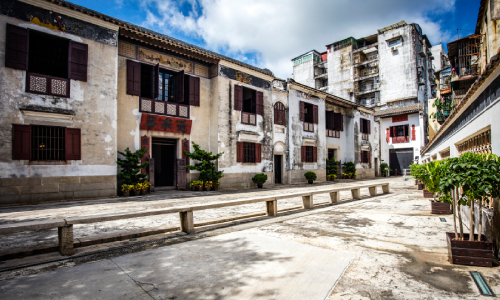
Mandarin's House
Built before 1869, this was the traditional Chinese residential compound home of prominent Chinese literary figure Zheng Guanying. It is a traditional Chinese compound consisting of several courtyard houses, displaying a mix of Chinese and Western detailing, such as the use of grey bricks against arched ornamentations and Chinese timber lattice windows against mother-of-pearl window panels of Indian origin.
Recommended Food in Macao:
.jpg?iar=0&w=500&mw=1920)
Crab Congee
Macao Crab Congee is one of Macao's most representative authentic delicacies. This dish features a smooth Cantonese congee base, slow-cooked with fresh local water crabs and crab roe. The congee completely absorbs the essence of the seafood, delivering a golden, rich, and incredibly sweet flavor profile. As a coastal city located near the Pearl River Estuary, Macao offers the perfect environment for water crabs, which thrive where fresh and saltwater mix. This unique habitat results in plump, meaty, and exceptionally sweet crabs.
.jpg?iar=0&w=500&mw=1920)
Portuguese Roasted Suckling Pig Stuffed with Rice
Portuguese Roasted Suckling Pig Stuffed with Rice is a highly representative signature dish in Macao. It blends the essence of crispy Portuguese roast suckling pig with Chinese fried rice. The suckling pig skin is roasted to an ultimate golden crisp, while the meat inside remains tender and juicy. The fried rice absorbs the rich essence of the pig fat, making it savory and aromatic with incredibly rich layers of texture.
.jpg?iar=0&w=500&mw=1920)
Portuguese Egg Tarts
Macao Portuguese Egg Tart (Po Tat) combines the caramelized surface of the traditional Portuguese pastry, Pastel de Nata, with the smooth, velvety filling of a British egg tart. Its most defining feature is the crisp, flaky puff pastry with dozens of delicate layers, paired with a richly aromatic custard that is deeply milky and marked with signature caramelized spots. This iconic treat has officially been listed as part of Macao's intangible cultural heritage.
.jpg?iar=0&w=500&mw=1920)
Fried Codfish Balls (Pastéis de Bacalhau)
Fried codfish balls are an iconic delicacy of Macao, though they originated as a traditional Portuguese home-cooked dish. "Ma Gai Yau" (Bacalhau) is the Cantonese transliteration of the Portuguese word for "salted cod." As the Portuguese settled in Macao, this dish integrated into the local culinary culture, becoming an indispensable classic appetizer or snack in Macanese cuisine (an intangible cultural heritage).
.jpg?iar=0&w=500&mw=1920)
Portuguese Clams
"Portuguese Clams" (Amêijoas à Bulhão Pato) is a classic Macanese-Portuguese dish. This dish features fresh clam as the star ingredient. Its soul lies in olive oil, plenty of minced garlic, white wine, and fresh coriander. It delivers a hint of lemon tartness and wine aroma. The sauce is extremely flavorful. It is typically paired with French bread to dip into the broth.
Information provided by the Macao Government Tourism Office. For more Macao travel information, please visit the Macao Government Tourism Office website.